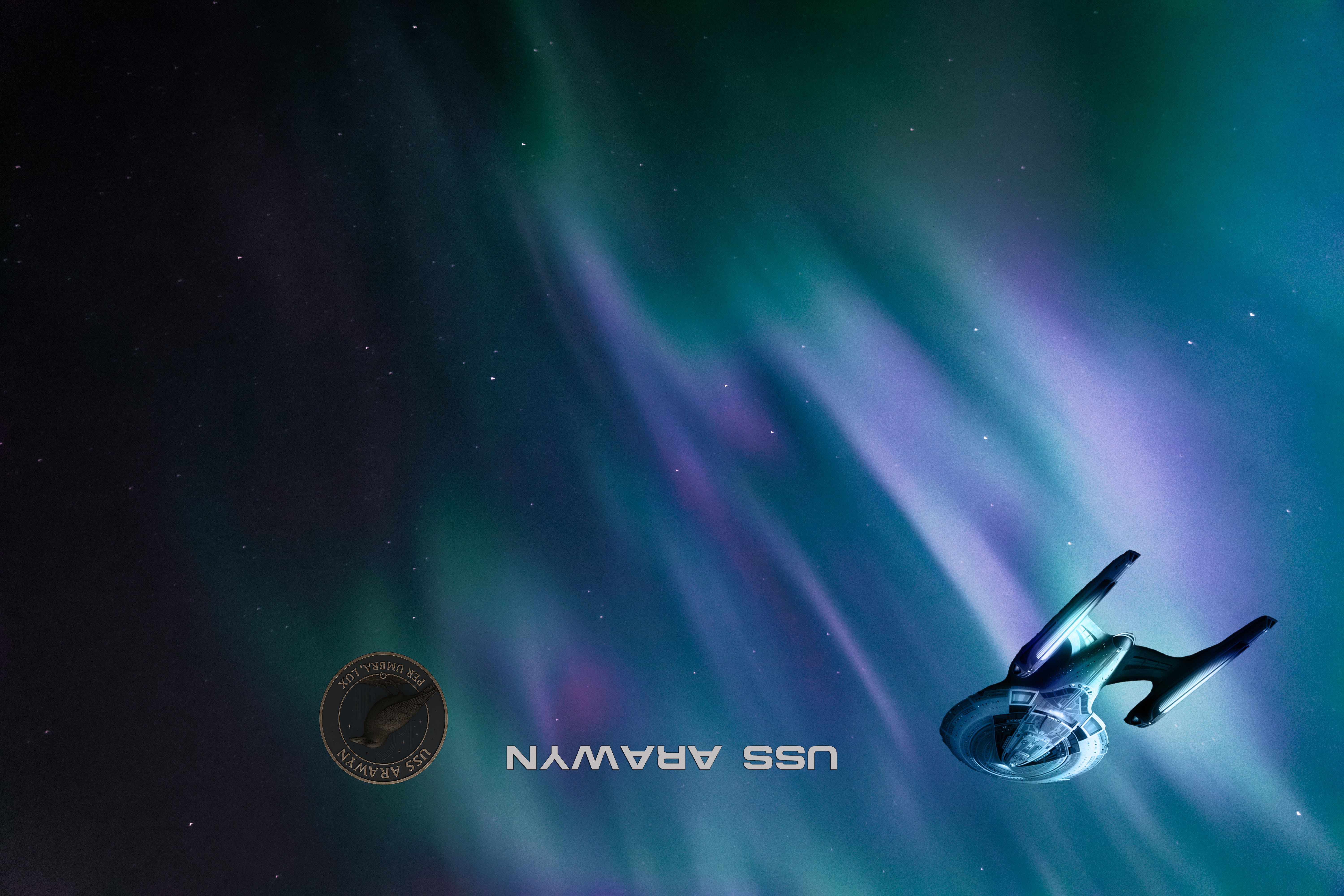


Quiet Through the Lattice
Posted on 03 Apr 2026 @ 6:58pm by Captain Sabrina Corbin
1,207 words; about a 6 minute read
Mission:
Arawyn’s Itchy Trigger Finger
Location: Bridge
// Bridge :: USS Arawyn //
The bridge had settled into a quieter kind of tension.
Not the sharp edge of impact and immediate response, but something sustained. Controlled. Every console active, every station engaged, without the frantic energy that had defined the first moments of the attack.
Captain Sabrina Corbin stood at the center of it.
She had not sat.
The asteroid still dominated the viewscreen, a jagged shield of stone holding the worst of the field at bay. Beyond it, the lattice remained. Silent now. Present in a way that felt deliberate.
Her gaze moved once across the displays, then settled.
“Report.”
McKinney’s voice carried from Tactical, steady. “No further weapons activity, Captain. The network remains active. I am continuing to map the gaps between nodes.”
“Engineering.”
A faint distortion, then the reply.
“Collingway here, Captain. We are stable for the moment. Containment fields are holding. We are still isolating damaged sections.”
Corbin inclined her head slightly. “And the shield draw?”
A brief pause.
“Still present. It does not match internal demand or damage loss. It is external.”
Corbin’s attention shifted.
“Define external.”
“It is not a drain in the traditional sense,” Collingway said. “More like a continuous interaction. The shields are being engaged. Constantly.”
Corbin looked toward the viewscreen, though her focus had moved beyond it.
“To the lattice.”
“Yes, Captain.”
She turned slightly.
“Commander Batenburg.”
Her XO had not left the coordination flow since the moment the bridge stabilized. One hand rested near the secondary console as she worked between departments, her attention split with practiced precision.
“Yes, Captain.”
“Work it through Science,” Corbin said. “If the system is structured, I want to know what it recognizes.”
Batenburg gave a single nod, already turning back to her console.
“Remington, feed me your latest telemetry analysis. Strip the interference and focus on repeating signal patterns.”
A pause, then the response came through from Science.
“Sending now, Commander.”
Batenburg’s eyes moved across the incoming data, her expression sharpening as the noise fell away and structure began to emerge.
“Captain,” she said after a moment, “the mesh is not communicating randomly. There is a consistent pattern in how it interacts with us. It is classifying.”
Corbin’s gaze narrowed. “Of us.”
“Yes.”
McKinney added, concise. “Tactical confirms. The nodes are running low-frequency sweeps across our shield envelope. Continuous. No active targeting.”
“Reading,” Corbin said.
“Yes, Captain.”
Corbin stepped closer to the central display, isolating shield telemetry.
“Engineering. Has the shield harmonic shifted since the initial impact?”
“No, Captain,” Collingway replied. “It adapted during the first exchange and we locked it to prevent further fluctuation.”
Corbin watched the data.
Then—
“That is why it stopped firing.”
Batenburg followed immediately. “The system recognized the modulation.”
“As something known,” Corbin said.
McKinney’s voice was quiet. “Or something permitted.”
Corbin straightened.
“The network is not draining our shields,” she said. “It is interrogating them.”
Collingway responded, more certain now. “That aligns with what we are seeing. A continuous exchange, not depletion.”
Corbin looked to Batenburg.
“And the result?”
Batenburg did not hesitate.
“Friendly, Captain.”
The word settled across the bridge.
No comfort in it.
Only clarity.
Corbin’s gaze returned to the field beyond their cover.
“If that classification changes, we will not have time to recover.”
“No, Captain,” McKinney said.
Silence followed.
Not uncertainty.
Calculation.
Batenburg was already moving again, coordinating quietly with Science, refining the signal parameters, ensuring nothing drifted.
Holding the line.
Corbin felt the weight beneath it all. Not fear. Something quieter. Controlled.
Three names.
Three absences.
She did not let it reach her voice.
“We have our answer.”
Her posture shifted, decision settling into place.
“Helm.”
“Aye, Captain.”
“We are done hiding behind this asteroid. Plot the mapped route. Thruster drift until we clear the shadow, then minimal impulse. No sudden changes in shield output.”
“Aye.”
Corbin’s gaze moved across the bridge.
“Tactical. Continuous monitoring. The moment the lattice behavior changes, I want it called.”
“Yes, Captain.”
“Commander Batenburg,” she said, more directly now, “you maintain coordination with Science. I want that harmonic held exactly where it is.”
Batenburg met her eyes briefly. “Understood, Captain.”
“Engineering,” Corbin continued, “you prioritize stability. If that lock begins to drift, I want it reported immediately.”
“Yes, Captain.”
Corbin drew a slow breath.
“Helm. Bring us out.”
The Arawyn moved.
Slowly at first, easing away from the asteroid that had shielded her. The edge of stone slipped across the viewscreen, revealing the field beyond.
No response.
No weapons fire.
Only the silent structure of the lattice.
“Distance to nearest node,” Corbin asked.
“Two thousand three hundred kilometers,” McKinney replied. “Holding.”
“Shield status?”
Batenburg answered without looking away from her work. “Stable. Harmonic unchanged.”
The ship continued forward.
Careful. Measured.
Every meter deliberate.
Corbin remained standing, hands clasped lightly behind her back, gaze fixed ahead while her awareness tracked everything. Power flow. Shield integrity. Tactical overlays.
And beneath it all, the weight of what they had already lost.
If this failed, it would cost more.
She did not allow the thought to form.
“Approaching midpoint of the field,” Helm reported.
No change.
No reaction.
The lattice continued its silent observation, the low-level interaction with their shields constant but no longer hostile.
Corbin allowed the smallest breath to leave her.
Not relief.
Not yet.
“Continue.”
Minutes passed.
The density of the field began to thin.
“Captain,” McKinney said, “no change in classification. We remain non-hostile.”
Corbin inclined her head. “Maintain course.”
Then—
“We are clear of the inner lattice.”
The words settled across the bridge.
Corbin kept her gaze forward until the last of the dense field fell behind them, replaced by open space.
“Take us to a safe distance. Full stop once we are clear of any residual nodes.”
“Aye, Captain.”
Only then did she shift.
“Commander Batenburg, transmit a hazard beacon. Mark this region as an active automated defense field. Full sensor logs attached.”
“Yes, Captain.”
“Flag it for Starfleet Command,” Corbin added. “They will want a dedicated survey team.”
There was no doubt in that.
The Arawyn slowed, then came to rest.
Alive.
Damaged.
But intact.
Corbin remained standing a moment longer, her gaze lingering on the space they had crossed.
Three lives.
Gone.
Her expression did not change.
“Damage reports,” she said, her voice steady.
Her gaze remained forward a moment longer before shifting slightly.
“Engineering,” she said. “Confirm. Has the shield interaction ceased since we cleared the field?”
A brief pause.
“Yes, Captain,” Collingway replied. “The external engagement has dropped to zero. Shield systems are no longer being pinged.”
Corbin inclined her head once.
“Good.”
She let that settle, just briefly.
Medical and Engineering would be engaged for hours yet. Stabilization, repair, accounting for damage that went deeper than what the initial reports would show.
She had already moved past it.
“Helm, set course for Starbase Three Six Nine. Warp six.”
“Aye, Captain.”
The stars stretched as the Arawyn slipped back into warp, leaving the silent lattice behind.
What had been intended as a routine stop would now become something else entirely. Hull repair. Recovery. Time they had not planned to spend.
A week’s journey.
Corbin did not look away from the stars.
“Let us get her home.”
Captain Sabrina Corbin
Commanding Officer
 RSS Feed