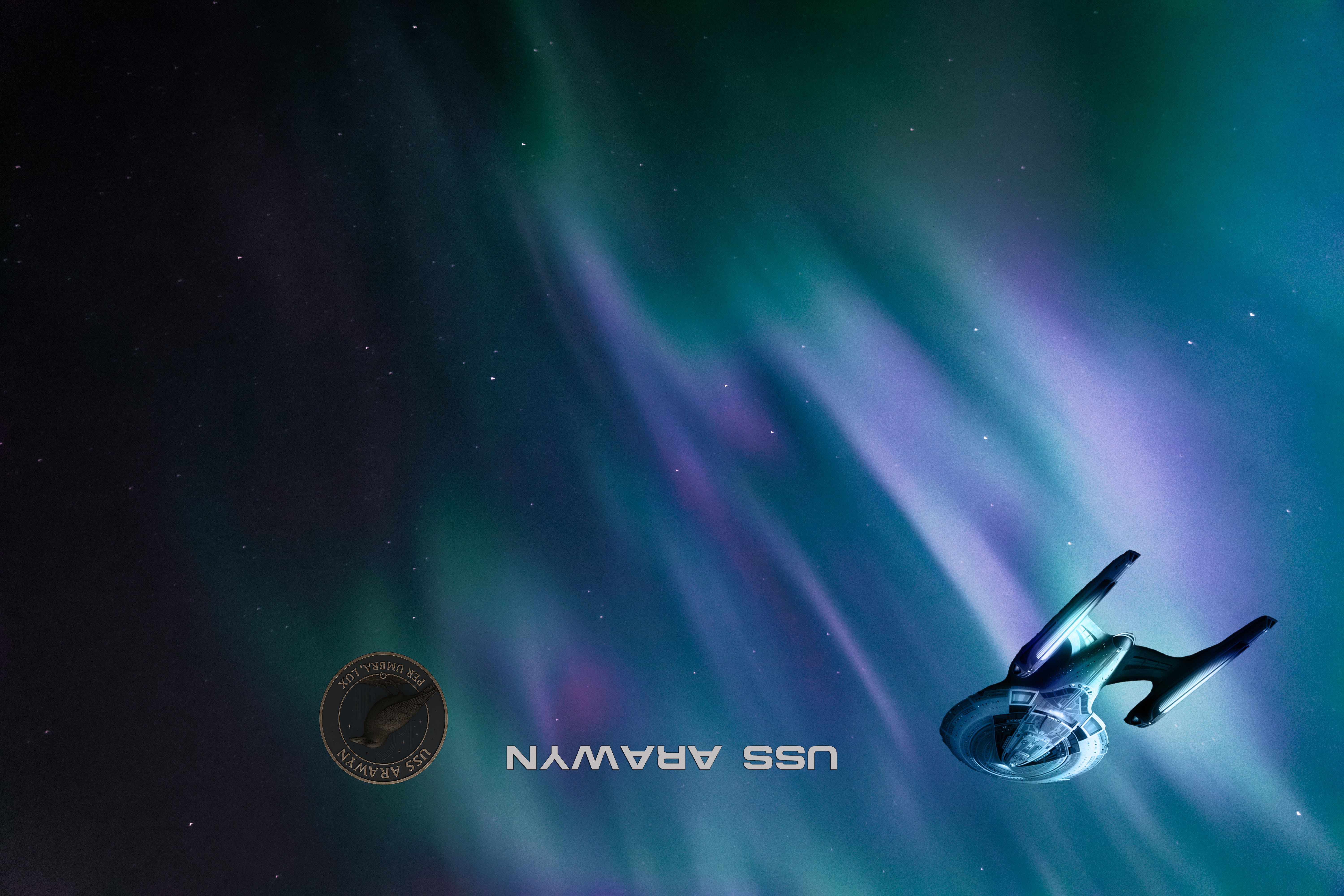


The Signal Beneath the Static
Posted on 23 May 2026 @ 12:33am by Captain Sabrina Corbin
1,956 words; about a 10 minute read
Mission:
Time After Time
Timeline: Directly After the Events in "The Night the Freeway Went Silent "
The Arawyn had left Starbase 369 weeks ago, slipping back into the stars with less ceremony than Sabrina Corbin had expected and more quiet than she fully trusted. Since then, the journey had been almost indecently calm. They had made a brief stop at a lonely outpost clinging to the edge of Federation support routes, offloading supplies and replacement components to a remote station that seemed held together by stubbornness and recycled air. They had answered a distress call from a freighter with a fractured plasma manifold and spent the better part of two days helping her limp back to warp-capable status. After that came star-charting, long stretches of sensor sweeps, stellar mapping, and the kind of orderly, useful work that reminded Corbin why Starfleet still mattered when the universe was not actively trying to kill anyone.
She should have been pleased.
Mostly, she was.
Captain Sabrina Corbin sat in the command chair with one leg crossed neatly over the other, a PADD resting against her knee. The bridge hummed around her in its usual rhythm: quiet reports, soft console tones, the almost subliminal vibration of a Sovereign-class starship at warp. It was not silence. It was discipline.
Commander Suzanna Batenburg stood just to her right, reviewing the latest operational summaries from Engineering and Science. Her expression was composed in the particular way Corbin had come to associate with the Vulcan side of her heritage. Not emotionless, never that, but carefully measured. Every reaction passed through analysis before it was permitted onto her face.
“Stellar Cartography confirms the updated grid is complete through section fourteen,” Batenburg said. “Science is requesting another six hours before they are comfortable calling the region fully mapped.”
Corbin did not look up from her PADD immediately. “Science is rarely comfortable calling anything fully mapped.”
“No,” Batenburg replied evenly. “However, in this instance, their caution is statistically defensible.”
That earned the faintest curve at the corner of Sabrina’s mouth.
“Then we shall allow them six more hours of defensible caution.”
The words had barely left her mouth when the bridge lighting flickered.
Not failed.
Flickered.
A subtle ripple passed through the deck plates, so faint it might have been dismissed as a power fluctuation if every console on the bridge had not chirped at once.
Corbin’s eyes lifted.
“Report.”
At Operations, Lieutenant Oliver Jung’s hands moved over the console with quick, practiced precision. “Sensor spike, Captain. Bearing zero-two-one mark seven. Very brief. Not on the standard subspace band.”
“Natural phenomenon?” Batenburg asked.
“Checking,” Jung replied, his voice tightening as more data populated his screen.
At Tactical, Lieutenant Commander Grayson McKinney had already straightened. His attention sharpened with the immediate, physical stillness of a man who did not need an alarm to tell him when something had changed.
“I’m reading a low-level energy distortion ahead,” McKinney said. “No vessel signatures. No weapons lock. No immediate threat profile.”
Corbin set the PADD aside and stood.
“Helm, drop us to impulse.”
“Aye, Captain.”
The stars on the viewscreen collapsed from streaks into points.
For a moment, nothing appeared unusual. Empty space stretched ahead, dark and indifferent, scattered with distant suns. Then the sensors adjusted, and the main viewer overlaid a faint shimmer against the black. It was barely visible, a distortion in the starfield, like heat rising from pavement on a summer road.
Corbin’s brow tightened.
“Science.”
The officer at the Science station leaned closer to her readings. “Captain, I’m detecting chronometric particles. Significant concentration. There are also gravimetric shear readings, atmospheric distortion, and what looks like a localized subspace fold.”
“A fold around what?” Batenburg asked.
The Science officer hesitated.
Corbin turned slightly. “Lieutenant?”
“There is a planet, Captain.”
The bridge stilled by a degree.
Corbin looked back to the viewer. “There was no planet on our charts.”
“No, Captain. There should not be one here. Long-range scans are resolving a Class-M body approximately point-eight AU from the local primary.” The officer’s fingers moved quickly. “Small. Stable orbit. Atmosphere breathable by Federation standard. Water signatures, vegetation, active weather patterns.”
Jung turned from Ops, his expression far more serious now. “Captain, that is not the strange part.”
Corbin’s gaze shifted to him. “By all means, Lieutenant. Do not ration the strangeness.”
He transferred his data to the main viewer. “We’re receiving electromagnetic transmissions from the planet.”
The shimmer sharpened.
Static hissed through the bridge speakers, thin and uneven. Jung adjusted the filters, separating the stronger commercial broadcast from the surrounding noise. For a moment, the sound fractured into overlapping bands: emergency tones, low-band chatter, a burst of distorted speech. Then the interference cleared just enough for music to spill across the bridge.
The last bright bars of “Jump” by Van Halen played through tinny static, all synthesizer and guitar, absurdly alive against the stillness of the Arawyn’s bridge. Corbin did not recognize the rock song. The song ended beneath the fading echo of a station bumper, and a man’s voice came in with the casual confidence of someone filling time between records.
“…KROQ Los Angeles. Tuesday, May fifteenth, nineteen eighty-four. If you’re just joining us, yes, that was a little shaker. Officials are calling it minor, but we’re getting scattered reports of power outages through parts of Sherman Oaks, Studio City, and Van Nuys. Phone service seems spotty in a few neighborhoods, and traffic on the one-oh-one is… well, stranger than usual.”
A faint chuckle followed, too casual for what the bridge crew was seeing on their sensors.
“For continuous updates, tune over to our sister station on the AM side. They’ll keep you posted as more comes in. For now, stay cool, Los Angeles. Here’s ‘Time After Time’ by Cyndi Lauper.”
The opening notes began, soft and unmistakable, before the anomaly dragged the signal sideways into static.
The bridge went very quiet.
Jung’s hands froze above the console for half a second before he resumed filtering.
Batenburg looked from Operations to Corbin, one brow lifting with restrained precision. “Nineteen eighty-four.”
Corbin did not answer right away.
On the viewer, the planet rotated slowly beneath sensor enhancement. Clouds swirled over unfamiliar continents. Science magnified one region. A contained atmospheric disturbance glowed faintly near the surface, irregular and enclosed, pulsing with chronometric static.
Inside the distortion, the sensors began to resolve details.
Road grids.
Structures.
Combustion engine emissions.
Power lines.
Radio transmissions.
Science spoke carefully. “Captain, based on the signal structure, language, electromagnetic pollution, and technology signatures, we may be looking at a late twentieth-century Earth settlement.”
Batenburg’s hands clasped neatly behind her back. “On an uncharted planet. Four hundred and forty-two years out of temporal alignment.”
Her voice remained controlled, but Corbin heard the weight beneath it. Vulcan composure did not erase the absurdity of the conclusion; it simply gave it a cleaner edge.
“Not a simulation?” Corbin asked.
“No indication of holographic projection,” Science replied. “The readings are physical. Matter, atmosphere, infrastructure, biological life. All real.”
McKinney’s voice came from Tactical, lower now. “Captain, there are no orbital defenses, no active satellites, no detection grids. Nothing that would suggest they’re aware of us.”
“No,” Corbin said softly. “They would have no reason to look for us.”
Jung looked back over his shoulder. “Captain, there are civilian radio bands all over the place. Emergency chatter, local broadcast fragments, police frequencies, private transmissions. They think there’s been an earthquake.”
Corbin’s eyes remained fixed on the planet.
An earthquake.
A minor event, perhaps. A familiar inconvenience to people living in Southern California. Something that rattled glasses, sent parents to doorways, and then became a story told over dinner.
Only this time, when the ground stopped moving, the world had moved with it.
“Any indication they know where they are?” Batenburg asked.
“No, Commander,” Jung said. “Not yet. Most communications suggest infrastructure failure. Power loss. Road closures. Telephone outages. There are some references to missing freeway noise and aircraft silence, but nothing organized.”
“Then they do not understand,” Corbin said.
“No, Captain.”
The words settled over the bridge.
Corbin turned at last, and when she did, the softness was gone from her face. Not cruelty. Not detachment. Command.
“Yellow Alert.”
McKinney acknowledged at once. “Yellow Alert. Shields to standby.”
“Helm, hold position outside the distortion envelope. Keep us clear of the field until Engineering and Science have modeled the interaction risk.”
“Aye, Captain.”
“Science, I want every passive scan we can take without disturbing that anomaly. Chronometric mapping, atmospheric integrity, boundary behavior, energy source, anything that tells us whether this thing is stable or collapsing.”
“Yes, Captain.”
“Lieutenant Jung, isolate those transmissions. Build a timeline from the civilian broadcasts. I want the local time, the reported date, what they believe has happened, and whether any local authorities are beginning to understand the scale of it.”
Jung nodded. “Aye, Captain.”
“Commander Batenburg,” Corbin said, turning to her XO. “Assemble senior staff. Full briefing in twenty minutes. Engineering, Security, Tactical, Science, Operations, and Medical. I want Doctor Amberlyn prepared for twentieth-century human baseline physiology, possible exposure effects from the boundary, and mass casualty contingencies if that field begins to fail.”
Batenburg’s answer was immediate. “Understood. I will also have Medical review period-appropriate pathogen profiles and vaccination gaps. If these civilians are from 1984, their immune histories will not align with modern Federation standards.”
Corbin gave a small nod of approval. “Good. Include that.”
Batenburg looked once toward the viewer, her expression held in careful reserve. “Captain, the Prime Directive implications are considerable.”
“They are,” Corbin said. “And they are not theoretical. These are humans from Earth’s own past.”
“That makes the situation more complicated, not less.”
“Yes,” Corbin replied quietly. “I know.”
For a moment, neither woman said anything.
The planet turned beneath them, beautiful in the abstract way all inhabited worlds were beautiful from orbit. But Corbin’s attention stayed fixed on the shimmer near the surface, that impossible wound in time holding streets, schools, shops, children on bicycles, parents calling from screen doors, and people who had gone to bed believing the future was something that would arrive one ordinary day at a time.
“Captain,” Science said, voice quieter now. “There’s something else.”
Corbin did not turn. “Go ahead.”
“The chronometric field is fluctuating. Not rapidly, but enough to suggest it may not be permanently stable.”
Batenburg’s jaw tightened by the smallest visible degree. “Define unstable.”
“I can’t yet. It may be settling. It may be degrading. Or the enclosed region may still be adjusting to its displacement.”
McKinney glanced back from Tactical. “If that boundary fails?”
Science hesitated. “We do not yet know what happens to anything inside it.”
Corbin absorbed that.
Outside the windows of the Arawyn, the stars remained still. Down below, somewhere inside that impossible valley, radios crackled, streetlights failed, and the people of Tuesday, May 15, 1984 waited for help from a world that no longer existed as they knew it.
Sabrina’s voice was calm when she spoke again.
“Then we had better understand it quickly.”
She turned from the viewer, already moving toward the ready room.
“Commander, you have the bridge until the briefing. No active scans without my authorization. No probes into the field. No contact. Not yet.”
“Aye, Captain.”
Corbin paused at the ready room doors and looked once more at the distortion glowing faintly on the screen.
It was not an enemy.
Not yet.
It was not a distress call in the usual sense.
It was worse.
It was history, alive and terrified, asking for rescue without knowing anyone was listening.
“Let’s be very careful,” she said.
Then the doors opened, and the bridge went back to work.
Captain Sabrina Corbin
Commanding Officer
USS Arawyn
 RSS Feed