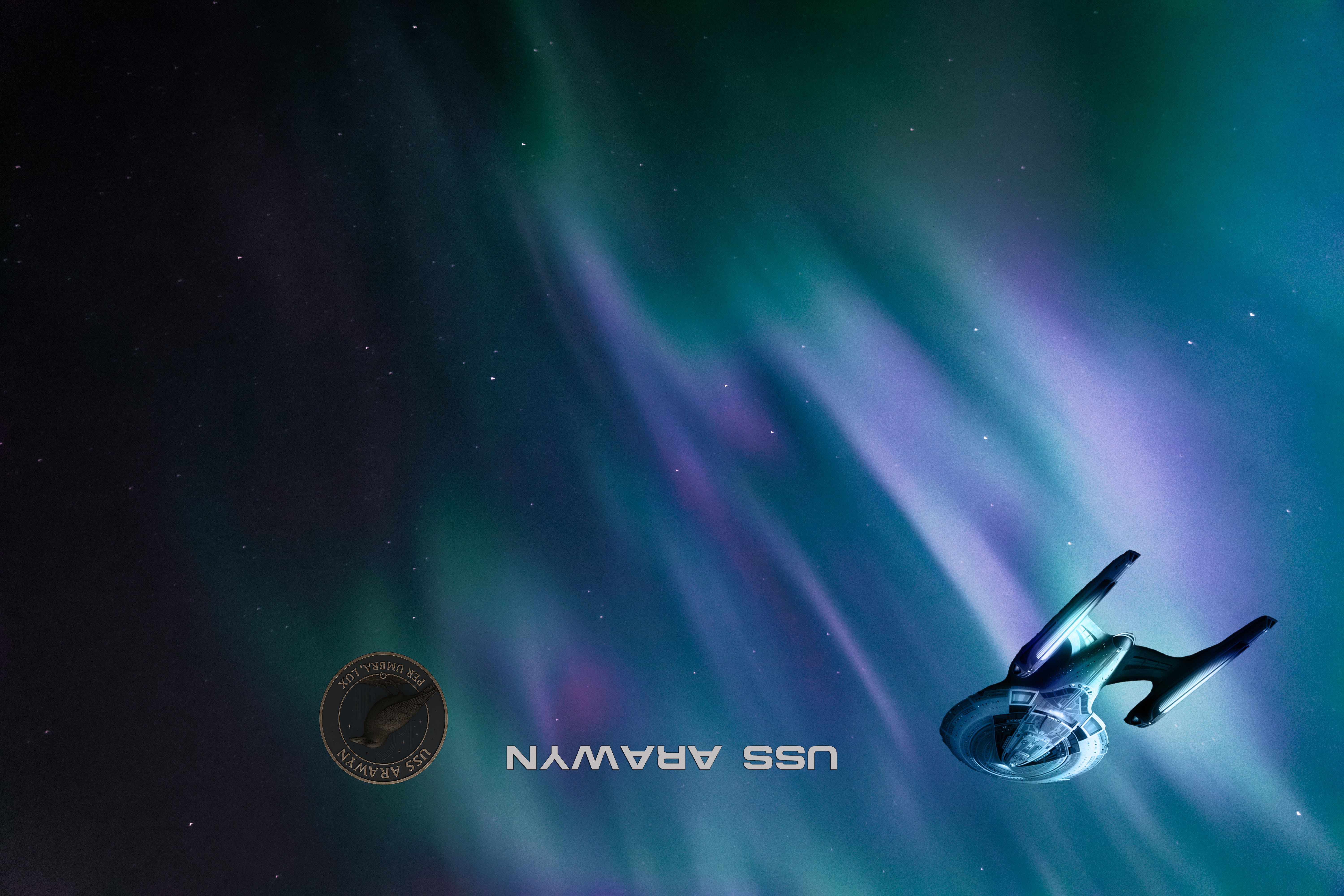


Magic Part I
Posted on 25 Jun 2026 @ 3:39am by Lieutenant Commander Claire Dunross MD & Captain Sabrina Corbin & Lieutenant Commander Grayson McKinney
1,959 words; about a 10 minute read
Mission:
Time After Time
Location: USS Arawyn
// Bridge, USS Arawyn //
The old warships were still on the viewer when Batenburg stepped into the turbolift, the doors closing on the away team before Corbin allowed herself to look away from the impossible battle above Sherman Oaks. The Klingon D7 and Romulan Bird-of-Prey cut across the upper atmosphere in hard, violent arcs, too ancient for the Arawyn’s present and too close to the frightened neighborhood below.
“Lieutenant Jung, open a channel to both vessels,” Corbin ordered. Her voice remained even, though the red alert lighting made every face on the bridge look sharper than it had a few minutes before. “Standard Starfleet identification first. If they ignore us, move through historical Klingon and Romulan frequencies appropriate to their apparent era.”
“Aye, Captain,” Jung replied from Ops.
Corbin kept her hands loosely clasped behind her back, watching as another flash of weapons fire burned between the two ships and vanished against the edge of the distortion. “Unidentified Klingon and Romulan vessels, this is Captain Sabrina Corbin of the Federation starship Arawyn. You are operating within a protected humanitarian zone. Cease fire and respond.”
The hail went out.
Nothing came back.
For several seconds, the bridge heard only the soft pulse of Red Alert and the disciplined motion of officers holding their stations. Then, on the viewer, the D7’s weapons flare dimmed. The Romulan ship rolled away from its next attack vector and held position, damaged wing trailing light into the false evening sky.
Corbin did not relax.
“Well,” she said quietly, “that is not an answer, but it is an improvement.” Her gaze shifted toward Tactical. “Commander McKinney, I want to know whether either of those ships matches anything in our records. Not class profile. Registry, hull markings, battle damage, engine signature, anything that tells us they belong to our history.”
She looked back to the viewer, where two ships from another century now hung silent above a stolen California sunset.
“And while you’re at it, tell me how hard we can poke them before they remember they were shooting at one another.”
Grayson had both ships boxed on his board before Corbin finished the sentence, his hands easy on the rail of the tactical console while the board finished its read in amber. The D7 hung where the hail had stopped it, weapons cooled and not powered down, a banked fire waiting for a reason. The Bird-of-Prey held its distance on a torn wing, light bleeding off the ragged edge into a dusk that belonged to nobody. He did not trust the quiet. Quiet, in his experience, was the part of a fight where everyone reloaded.
"Captain, the markings are textbook 2260s," he said.
"Klingon D7, Romulan Bird-of-Prey, the kind of hulls first-years build from replicator scrap and pride. Registry glyphs, scorch patterns, all period. The drives, though, don't match a thing in our files. Built from a very good record, or the distortion painted them the same way it painted a Tuesday in 1984 down there."
He let the harmonics finish climbing the display before he committed to either answer, because the difference decided a good deal more than this standoff.
"The data presents two conflicting readings, and neither offers a simple conclusion. On the one hand, they might be fabrications, imperfect recreations born of distortion and an ancient recording. Power curves too clean to be true, no wear in the plating, the same handful of seconds looping seamlessly under the hull, the way nothing with a living crew aboard ever runs. Period-correct on the surface, hollow underneath. Ghosts in the right paint."
With a precise, understated gesture toward the viewscreen, he continued.
"Conversely, they could be exactly what they appear to be: two crews ripped from their own time, battered and disoriented, staring at a sky they don't recognize, just like the residents below. The damage to that wing supports the theory. The scoring aligns perfectly with D7 disruptor patterns, and she's hemorrhaging drive plasma like an open wound. Ghosts don't bleed."
For him, this wasn't a mere intellectual exercise. He could disperse a hollow echo with a single graviton pulse without a second thought. But if these were living people pulled across four hundred years, cornered, terrified, and volatile, there was no taking back a fatal mistake. He refused to gamble on a guess. His targeting array remained fully charged, holding two active solutions without emitting any signal that the primitive sensors of either era would flag as hostile. He had dialed the power up just enough to be felt.
"I have them both locked. If they so much as prime a disruptor, they'll find out I'm faster, and they already know it. They haven't found their manners; they've just found something bigger than themselves to look at. Curiosity is a better anchor for a standoff than goodwill ever was."
His voice remained level, sharpened by a cold, practical edge.
"The proud one is the real wildcard. A damaged Romulan with a grudge is the most dangerous variable in any engagement. That plasma launcher is the only thing out there that actually has a chance to hurt us, and it won't care what's caught in the crossfire. That needs to be considered, Captain.
He looked over at Corbin.
"By our standards, these are museum pieces. I can put either one to sleep before it finishes the thought. Choosing the soft road, however, preserves the truce and protects everyone beneath it. By deploying a wide graviton net, we can pin both vessels in place before anyone reaches for a launcher, ensuring no shots are fired and no new grievances are formed. It is essentially managing two combatants who are still looking for a fight. While slower than using phasers, this method is far easier to justify to a town that still believes it is experiencing a perfectly normal night."
The corner of his mouth eased, and the gravity came off his voice by a fraction.
"What's actually breathing aboard those two hulls is a question above my console, but I can hold them still long enough to ask."
“Prepare the graviton net, Commander. Wide field, minimum force necessary. I want them held, not crushed.” She glanced toward Ops. “Lieutenant Jung, keep the hails open on all historical channels. No threats, no demands beyond ceasefire and identification. If there is anyone aboard those vessels capable of answering, I want them to hear a calm voice every time they remember we exist.”
“Aye, Captain,” Jung replied, already working.
Corbin let the bridge settle into the next uncomfortable silence. The old ships remained where they were, suspended above the atmosphere like artifacts pinned under glass. No weapons fire. No answer. No movement toward the planet. For the moment, that had to count as progress.
A soft tone came from Ops. Jung looked down, then back toward the command well. “Captain, transporter room confirms the away team has departed. Signal resolution remained stable through transport.”
Corbin accepted that with a slight nod, though her eyes stayed on the viewer. “Maintain a lock on their comm signals as long as the distortion allows.”
“Aye, Captain.”
The turbolift doors open behind her. Claire Dunross stepped onto the bridge with the briskness of someone who had come straight from one duty into another, the last traces of transporter-room urgency still in her posture. Her gaze moved first to the old warships on the viewer, then to the sensor displays repeating along the bridge rails.
“Doctor,” Corbin said, acknowledging her without turning fully. “I take it our people have had their last sensible precaution.”
“They have had every sensible precaution I could press into their necks before they vanished,” Claire replied, dryly. Her attention had already found the science station. “Sickbay is standing by, but if the bridge can spare the console, I would rather monitor this from here.”
Corbin did turn then, just enough for the faintest approval to show. “Take Science.”
Claire crossed to the station without further invitation, sliding in beside the officer posted there and accepting the transferred feed with practiced ease.
Corbin looked back to Tactical, her expression composed but her voice lower. “Hold your faster option in reserve, Commander. If either of them turns weapons on the neighborhood, you do what you must to stop it. Until then, we keep them curious.”
Before McKinney could answer, a tone sounded from the science console. Claire looked down sharply, one hand moving across the display as the readings shifted faster than the station could comfortably categorize them.
“That is not the same distortion pattern,” she said.
Jung looked over from Ops. “Captain, I’m reading new contacts forming near the upper edge of the distortion. Multiple contacts. They’re not ships.”
Corbin’s eyes returned to the viewer.
Of course they weren’t.
Claire did not look up immediately.
The science console was already protesting the new contacts in a dozen quiet ways, cycling through classifications and rejecting each one almost as quickly as it found them. Not vessels. Not debris. Not probes. Not energy phenomena in any clean sense. The computer tried organism, hesitated, and then flagged the reading as insufficient.
“Aye, that is helpful,” Claire murmured, dry as dust, her fingers moving across the controls.
The feed sharpened by degrees. Mass first, though the readings flickered at the edges as if the contacts were not entirely committed to sharing the same physics as the Arawyn. Then motion. Deliberate motion. Not tumbling. Not falling. They turned, slowed, and curved around one another in long, fluid arcs.
“They’re moving under their own direction,” Claire said. “Or something near enough to it.”
On the viewer, the contacts resolved.
For one breath, Claire forgot the console.
They were enormous, pale things, long and serpentine, swimming through the dark between the Klingon and Romulan ships as if space had become some deep, invisible sea. Their bodies folded and uncoiled with a slow grace that looked gentle until the scale of them became clear. One drifted behind the D7, and its length seemed to continue far longer than sense allowed, a living ribbon of ivory and moonlit silver.
There were no wings. No nacelles. No visible mechanism of propulsion. No hull.
Only bodies.
Soft fur streamed from them in long veils, cream and white and silver, lifting around their forms as though caught in a current no one else could feel. Along their backs ran subtle ridges, softened beneath mane-like filaments that shimmered where the distortion touched them. Their faces were broad and strangely expressive, with dark eyes set beneath sweeping brows and long whiskers trailing from their muzzles.
One smaller creature curled close to a larger one. The larger creature bent around it in answer, protective or instinctive or merely beautiful in a way Claire did not yet trust.
“Mo chreach,” she whispered.
Then she made herself breathe and looked back down at the telemetry. Wonder could wait until after it stopped endangering everyone.
“I have mass,” she reported, her voice steadier now. “Irregular, but present. Biological indicators as well, though I would caution everyone that the word biological is doing a great deal of work at the moment.”
She adjusted the scan again, narrowing it across the nearest creature as its pale body passed through the upper edge of the distortion.
“No warp signature. No hull composition. No shield grid. No transponder. No conventional energy wake.” Her brow furrowed. “And no physiology that should survive vacuum by any rule I was taught at the Academy.”
Claire glanced toward the viewer again, watching the nearest creature turn its head toward the Arawyn with slow, dark-eyed attention.
“They are not ships, Captain,” she said. “And unless our sensors have taken up poetry, they are not simple ghosts either.”
[To be continued]
 RSS Feed