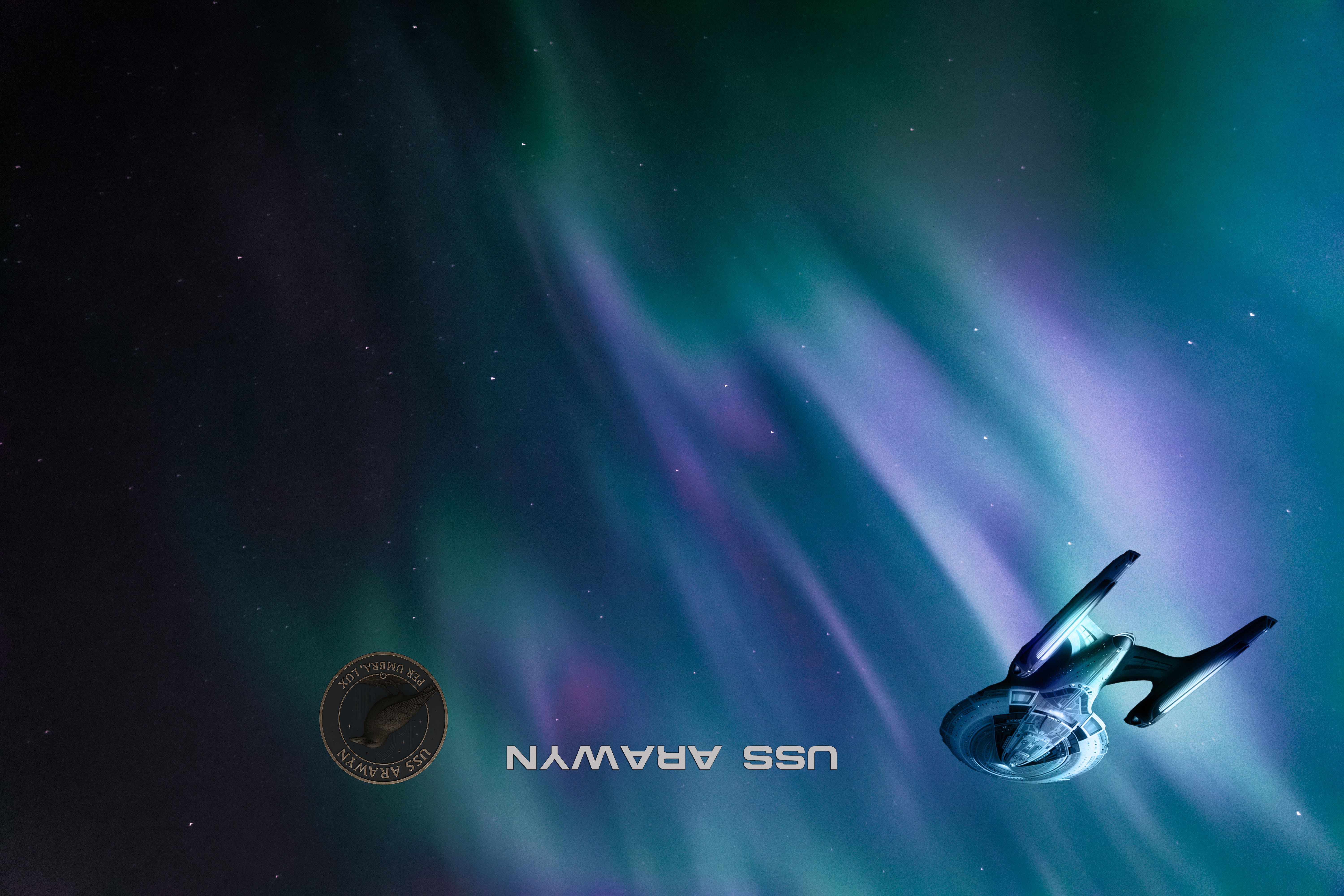


Relax
Posted on 19 Jul 2026 @ 10:49pm by Captain Sabrina Corbin
2,618 words; about a 13 minute read
Mission:
Time After Time
Location: USS Arawyn
Timeline: Concurrent with Shout
// Bridge, USS Arawyn //
“Batenburg to Arawyn.”
The channel broke through in fragments at first, the commander’s voice threaded with static and distortion. Lieutenant Jung leaned over his console at Ops, adjusting filters with both hands while the bridge remained held in the uneasy discipline of Red Alert.
Corbin turned from the main viewer. The Klingon D7 and Romulan Bird-of-Prey remained suspended above the upper atmosphere, trapped within Commander McKinney’s graviton net. Beyond them, the Veylith moved in long, pale arcs through space, beautiful and deeply inconvenient.
“Go ahead, Commander,” Corbin said.
Batenburg’s voice returned, clearer now, though still thin at the edges.
“The boy, together with a helper, is attempting to restore the damage that has been done. Until the process is complete, we must remain entirely neutral. That includes the Arawyn.”
Corbin’s expression did not change.
On the viewer, the Romulan vessel’s damaged wing flared, its plasma system flickering again as if it had remembered an old grudge.
Batenburg continued.
“His instructions are explicit: No weapons. No transporting. No attempts to move the ships. Do nothing that might frighten the Veylith. And no one is to keep any part of this phenomenon simply because it appears interesting.”
The final sentence landed across the bridge with a strange and pointed relevance.
Doctor Claire Dunross, still at Science, looked briefly toward Corbin.
Commander McKinney said nothing from Tactical, though Corbin could feel the unasked question there. They had two active hostile vessels contained near the atmosphere, living spaceborne entities behaving unpredictably, and an away team standing inside the collapsing remains of an impossible event.
Do nothing was not an order Starfleet officers enjoyed.
It was, however, sometimes the correct one.
Before Corbin could give the order, a secondary alert blinked at the auxiliary engineering station on the bridge.
Corbin noticed it because the officer seated there noticed it too late.
Lieutenant Junior Grade Mara Venn straightened abruptly, one hand moving across the console as a delayed status packet opened. Her face changed by the smallest degree, but it was enough.
Corbin turned her head. “Lieutenant.”
Venn looked up. “Captain, Main Engineering is requesting clarification on the away team’s status. It appears their last complete operational update was prior to Lieutenant Commander Remington and Lieutenant Collingway being reported missing.”
The bridge seemed to tighten.
Corbin did not raise her voice.
She did not need to.
“Explain why my Engineering department is learning the status of its Chief Engineer and Chief Science Officer by inference.”
Venn went pale. “Captain, with Red Alert conditions, the warships, and the Veylith contacts, the bridge feed was prioritized through Tactical and Science. Engineering was maintaining defensive power allocation and received only essential system directives.”
“That was not my question.”
“No, Captain.”
Corbin stepped closer, her expression controlled enough to be worse than anger. “Engineering is not a spectator department. It is not a lower-deck waiting room to be informed when the bridge finds a convenient pause. If this ship is at Red Alert, Engineering is part of the response. If an away team member is lost, Engineering has the right to know whether it is preparing for recovery, containment failure, combat damage, or casualty retrieval. Need-to-know does not mean keep them comfortable in ignorance.”
Venn swallowed. “Understood, Captain.”
“Do you understand, Lieutenant? Because I will be very clear. No department head, acting or otherwise, should have officers guessing whether their people are alive while they are expected to keep this ship functioning.”
The words were quiet.
The reprimand was not.
Several officers kept their eyes firmly on their consoles.
“Open a live command-status feed to Main Engineering,” Corbin continued. “Filtered for operational security, not stripped of relevance. Sorensen gets the same tactical and away team status summaries Tactical and Science are receiving, with Engineering-specific implications attached. If the signal degrades, he gets text updates at two-minute intervals until this situation resolves.”
Venn’s hands moved quickly. “Aye, Captain. Opening feed now.”
“And Lieutenant?”
“Yes, Captain?”
“This does not happen again.”
“No, Captain.”
Corbin held her gaze for one second longer, then turned back toward the viewer.
“Good. Now let us all endeavor not to give Engineering anything worse to report.”
She drew in a measured breath.
“Mr. Jung, acknowledge Commander Batenburg’s instructions. Tell her the Arawyn will comply.”
“Aye, Captain.”
“Commander McKinney,” Corbin continued, turning toward Tactical, “release the graviton net by degrees. Slowly. No pressure shifts, no sudden field collapse. I do not want either of those ships feeling as if we have let go of their throat all at once.”
McKinney’s hands moved across the tactical display. “Understood. Easing containment field by two percent intervals.”
“And if they begin firing?”
His eyes lifted.
Corbin held his gaze for a moment.
Then she said, “We do nothing unless the surface or this ship is under direct and immediate threat. Even then, minimum interference.”
“Aye, Captain.”
It was not the answer either of them liked.
That did not make it wrong.
“Doctor Dunross,” Corbin said.
Claire straightened slightly at Science. “The Veylith are becoming increasingly active. Their movement patterns have shifted toward the atmosphere.”
“Can they survive atmospheric entry?”
Claire gave her a look that was half incredulous, half offended on behalf of every medical textbook ever written. “Captain, they appear to be surviving vacuum without ships, suits, or any detectable protective field I understand. I am reluctant to impose my expectations on them at this stage.”
“Noted.”
On the viewer, the Veylith turned.
All of them.
The motion began with the smallest one, the calf curling downward toward the planet in a pale loop of motion. The larger beings answered, long bodies bending around it as if the entire pod had become one thought. Their fur streamed behind them, silver and cream and white, shifting in a current that did not exist.
Then they sang.
At first, the sound was not audible. It appeared on the sensors before it reached the bridge, a rising pattern across subspace bands, gravitational harmonics, and something the computer could not classify with any confidence. Claire’s console lit in cascading waves of impossible data.
Then the bridge heard it.
Softly.
Not through the speakers. Not exactly.
The sound seemed to arrive through the hull, through bone, through memory. A low, layered note, vast and mournful, threaded with something higher and frightened. The Veylith moved as they sang, descending through the upper atmosphere as if the planet’s air were no more substantial than light.
Jung looked up from Ops, startled. “Captain, the song is propagating through the distortion envelope.”
“Effect on the ship?”
“None measurable,” he replied, then hesitated. “But everyone is hearing it.”
Corbin glanced across the bridge.
No one had stopped working. That mattered. But faces had changed. Officers stared at their consoles with eyes a little too wide, hands moving by training while something older than training listened.
Corbin turned back to the viewer.
The Veylith passed into the atmosphere.
They should have burned.
They did not.
Their pale bodies became visible against the gold-blue sky above Sherman Oaks, enormous shapes folding through cloud and sunlight, untouched by pressure, friction, heat, or any other law that had apparently decided to take the evening off. The largest one moved low enough that its shadow crossed the amber-lit streets below.
“Local population?” Corbin asked.
Claire checked the feed. “The civilian pattern is degrading, but not in a conventional way. I am not certain they are fully present anymore. The entire fragment is becoming… less fixed.”
On the viewer, Sherman Oaks flickered.
One moment the neighborhood was there: palm trees, rooftops, boxy parked cars, quiet streets.
The next, something else showed through it.
A motel sign.
A police station.
A college building with a name Corbin could not quite read before it vanished.
A red-brown desert.
Then Sherman Oaks again.
Corbin clasped her hands behind her back.
“Steady,” she said.
It was not clear whether she meant the bridge, the ship, or herself.
At Tactical, McKinney’s console sounded a warning.
“The D7 is bringing weapons back online,” he said. “Romulan vessel is answering. Plasma system charging.”
“Of course they are,” Corbin said quietly. “Nothing settles an existential crisis like resuming an old war.”
On the viewer, the two ancient ships shifted inside the loosening graviton field. The D7’s disruptors brightened. The Bird-of-Prey rolled, damaged but determined, turning its wounded wing toward the Klingon vessel with suicidal dignity.
For one second, Corbin saw exactly what was about to happen.
Two ships from a dead century, ripped from their own battle, surrounded by impossible creatures, held by a starship they could not understand, and now released just enough to decide that destroying each other made far more sense than anything else in the sky.
“McKinney,” she said.
“I have them.”
“No firing.”
“I know.”
His voice was clipped, but controlled.
The D7 fired first.
Or tried to.
The disruptor beam stretched from its emitter, bright green and furious, then curved backward as if the space ahead of it had become a mirror. The Romulan plasma flare bloomed in answer, a brief, vicious flower of energy that never crossed the distance. It folded inward, thinning into light, then into nothing.
Both ships began to blur.
Their outlines pulled long, as though someone had taken hold of the far edge of them and drawn them through a narrow seam. The Klingon vessel resisted the longest. Corbin could almost imagine the crew aboard it refusing to yield out of pure ancestral stubbornness.
Then the D7 vanished.
The Bird-of-Prey followed half a heartbeat later.
The tactical display cleared so abruptly that the absence felt louder than the alerts that preceded it.
McKinney stared at the board. “Contacts gone.”
“Destroyed?”
“No. Removed. No debris, no energy bloom, no residual drive trail. Just gone.”
Corbin nodded once. “One hopes back to their own argument.”
The Veylith song rose.
Then softened.
One by one, the pale creatures disappeared from the atmosphere. The calf folded first, becoming a line of light too thin for the sensors to hold. The adults followed, each immense body slipping into a seam that closed behind it without violence. The final Veylith lingered longer than the others, head turned toward the planet, dark eye reflecting the false sunset below.
Then it was gone as well.
Claire let out a breath she may not have realized she was holding. “Veylith contacts have cleared.”
“Confirmed,” Jung said. “No remaining biological anomalies in orbit or atmosphere.”
The bridge remained silent.
Then the planet changed.
Not the whole planet. Only the scar where Sherman Oaks had been.
The amber boundary brightened once, becoming too sharp to look at directly. The frozen sunset inside it moved at last, sliding one impossible fraction toward night. Corbin saw rooftops, lawns, streets, tiny figures, cars, telephone wires, all of it overlaid with other versions of itself until the image became too dense for the viewer to translate.
Then the neighborhood folded out of sight.
There was no explosion.
No shockwave.
No final dramatic collapse.
It simply ceased to occupy the world in front of them.
The viewer showed a dusty red-brown expanse beneath a thin atmosphere, the unremarkable mineral surface of an uninhabited planet that had somehow become the most welcome thing Corbin had seen all day.
Jung’s voice broke the silence first.
“Captain… the fragment is gone.”
“Life signs?”
“Stand by.” His hands moved quickly. “Five Starfleet life signs on the surface. Commander Batenburg, Lieutenant Flammia, Lieutenant Commander Remington, Lieutenant Collingway, and Lieutenant Commander Amberlyn. No civilian life signs. No residual urban structures.”
Claire checked her own readings. “Atmosphere is thin but breathable for short exposure. Oxygen present, low partial pressure. Mineral particulates elevated. They should not remain down there unnecessarily.”
Corbin’s eyes remained on the viewer.
The away team stood where a cul-de-sac had been, small figures against red dust and stone.
Alive.
Abandoned, perhaps, but alive.
Corbin tapped the arm of the command chair.
“Corbin to Batenburg.”
For a moment there was only static.
Then the commander’s voice answered.
“Batenburg here.”
Corbin allowed herself the smallest dry exhale.
“I cannot wait to read this mission summary.”
A pause.
Even through the channel distortion, Corbin could almost hear Batenburg deciding whether that required an answer.
“I will endeavour to make it comprehensive, Captain.”
“I have every faith in you, Commander.” Corbin looked toward Ops. “Prepare to retrieve the away team. Standard biofilter, full decontamination protocol, medical priority on arrival.”
Jung nodded. “Transporter room standing by.”
“Commander Batenburg,” Corbin continued, “hold position. We are bringing you home.”
“Acknowledged.”
Corbin lowered her hand.
“Energize.”
The five life signs vanished from the surface.
A moment later, Jung confirmed, “Transport complete. Away team is aboard. Transporter Chief reports all five arrived intact.”
“Doctor Dunross,” Corbin said.
Claire was already moving. “On my way to Sickbay.”
“Full evaluation. Physical, cognitive, temporal, psychological. I want particular attention on Remington and Collingway.”
“You and me both,” Claire replied, and left the bridge without waiting for permission she clearly did not need.
Corbin looked back to the viewer.
The red-brown surface remained.
Quiet.
Empty.
Almost insultingly ordinary.
“Science,” she said, “full scan of the former fragment site. Subspace, chronometric, gravitational, biological, atmospheric, geological. If there is so much as a footprint left by this thing, I want to know what shape it is.”
“Aye, Captain.”
Minutes passed.
The Arawyn held position above the planet while every available sensor swept the area that had once been Sherman Oaks. Corbin remained standing. No one suggested she sit. No one commented on the fact that the bridge had not yet been released from Red Alert.
Reports came in one at a time.
No residual chroniton surge.
No active subspace shear.
No biological life signs beyond normal microbial traces.
No structural material.
No communications leakage.
No evidence of Klingon or Romulan vessels.
No Veylith song.
No twentieth-century suburb.
Only mineral dust, trace oxygen, and a landscape that looked as if it had been waiting several million years for everyone to stop being dramatic.
Corbin listened to the final report and nodded.
“Very well. Reduce from Red Alert. Maintain shields until we clear orbit.”
The bridge lighting shifted back toward normal, though it seemed to Corbin that no one entirely relaxed.
She did not blame them.
“Helm,” she said.
The helmsman turned. “Captain?”
“Plot a course out of this system. Any uncharted system within reasonable warp range that is not presently hosting displaced civilians, ancient warships, cosmic children, or singing space fauna will do.”
A beat passed.
Then the helm officer said, with admirable professionalism, “Aye, Captain. I have an uncharted system bearing one-four-seven mark three. Long-range sensors show no inhabited worlds and no artificial structures.”
“Splendid.”
Jung glanced back from Ops, cautious. “Captain, Starfleet will expect a preliminary report.”
“Starfleet may have one after Sickbay confirms my people are whole and after I have had enough tea to write the phrase ‘Juvenile Stage Four of the Meridian’ without sounding unkind.”
That earned the smallest release of tension across the bridge. Not laughter exactly. They were not there yet. But breath. Human, Vulcan, and otherwise.
It was a start.
“Helm,” Corbin said, settling finally into the command chair. “Take us out of orbit. Warp six once clear.”
“Aye, Captain.”
On the viewer, the red mineral planet began to drift away as the Arawyn turned from it. There was nothing left to see now. No golden hour. No cul-de-sac. No impossible ships in the sky.
Only a world that had briefly held too many stories and had, at last, been allowed to become quiet again.
The stars stretched.
The Arawyn went to warp.
Captain Sabrina Corbin
Commanding Officer
USS Arawyn
 RSS Feed