

When Rocks Strike Back
Posted on 30 Mar 2026 @ 3:41am by Lieutenant Commander Grayson McKinney & Captain Sabrina Corbin
1,750 words; about a 9 minute read
Mission:
Arawyn’s Itchy Trigger Finger
Location: Bridge
// Bridge //
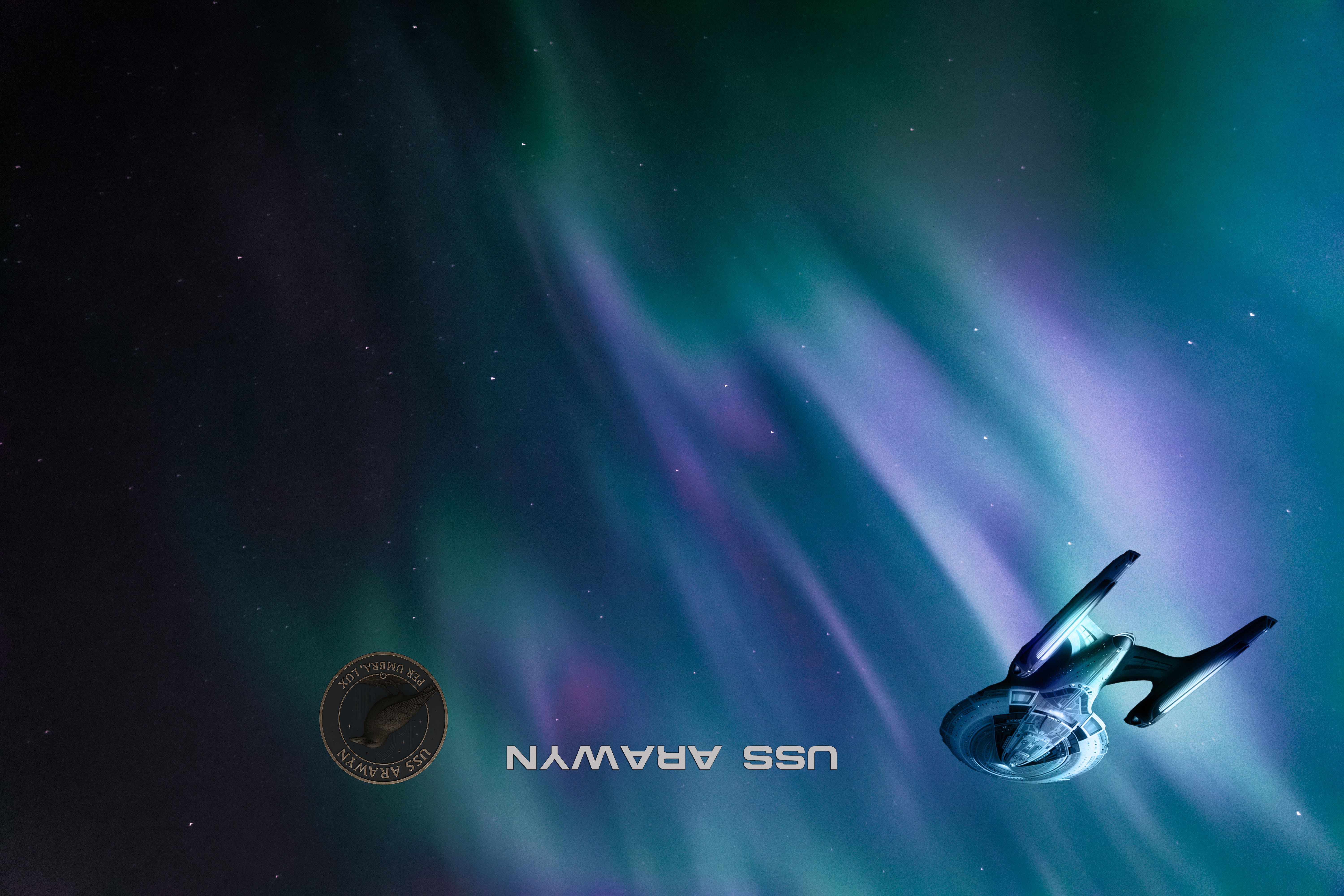
The Arawyn vibrated beneath Grayson's boots, a wounded animal holding its breath. Emergency lights bled crimson across the bridge, shadows pooling in the corners.
Grayson McKinney planted himself at the tactical console, knuckles whitening as he sorted through the red-lit chaos. He forced order from the storm. His voice cut through the noise, flat and precise, as he called out status. Starboard shields bled power, holding at forty percent by sheer will. Emitters pulsed, straining against collapse.
"Keagan," Grayson said. His voice was a low, steady rumble that cut through the bridge's taut silence. "Lock down the primary phaser arrays. They are cycling too slowly. We cannot rely on them if the target circles back. Reroute emergency reserves directly to the torpedo guidance systems."
"Primary arrays locked, Commander," Keagan replied instantly. Her fingers danced across the secondary tactical interface. "Cycle rate was under thirty percent. I've bypassed pre-fire chambers; EPS reserves feed guidance. Tubes one through four are hot and holding."
Grayson moved without pause. He slapped open the manual overrides, unlocked both magazines, and seized the controls. If they had to break through the Nabharak Shoals, energy weapons meant nothing. If it came to that, he’d fire every torpedo himself.
From the center seat, Captain Corbin’s voice registered in his periphery, quiet and anchoring. “We are still working to identify what engaged us. No pursuit, no follow-up fire.” She indicated the massive asteroid filling the viewscreen. “We are holding position here. I have a probe out to see what it brings back.”
"Probe telemetry is feeding to your station now, Captain," Grayson said. He did not look up from his display. "Forward and aft torpedoes are loaded and hot. We have a full yield ready when you give the word."
At operations, Denari's hands hesitated, his voice strained. "Data is a mess. I'm tracking forty-six trajectories clustered in six seconds. Impact scattered perfectly to exploit grid fatigue."
Grayson leaned in, eyes narrowed on the data stream. He knew violence—movement, aftermath, the signature of intent—but this attack mocked every instinct. Too many hits, too perfectly timed, and none of the tells he trusted. Wrong, his gut told him. An itch beneath the skin. Precision ambush, invisible hands. His grip tightened on the console. He hunted for a pattern and found only frustration, dread rising in its place. Every tactic failed. Uncertainty pressed at his chest, cold and relentless.
Forty-six impact vectors, perfectly coordinated, should have left propulsion scatter. Ships moved to fire; movement meant thrust, thrust meant heat. The display showed only a void. The attack came from blind spots, synchronized to the second, but left nothing—no thrust, no warp trails, no impulse exhaust, no heat at all.
It broke the rules. No ship hid its drive and struck like that.
Unless, Grayson thought, the attacker never moved.
He shut out the bridge, isolating the Captain’s probe feed. The scan swept over jagged silicate—the rock they clung to for cover—then drifted across scattered debris. Dead rock grinding against itself.
Except it was not dead.
Grayson zoomed in on the thermal spikes, fingers quick on the controls. He traced faint, rhythmic pulses to their source—not behind cover this time. He matched emission points to Denari’s vectors, eyes narrowing as the signals vanished beneath meters of iron-silicate shell.
His jaw set. He looked up at the main screen, taking in the glittering graveyard of the Shoals. Not a cloaked starship. Not a derelict.
The rocks themselves were armed. Grayson’s gaze locked on the massive asteroid anchoring them. As he studied the silent colossus, a pattern shimmered at the edge of awareness—a geometry in the debris too deliberate for chance. Faint, angular scars marred the surface, not made by nature or impact. A chill crept through him. Someone, or something, had built this. Traps set with ruthless precision. The Shoals watched them, but something else watched from behind the stone, patient and unseen.
“Captain," Grayson said, his voice tight with the strain of a man looking at a ghost. "The impact angles don't trace back to empty space. And there's zero residual thrust scatter in the vacuum. Look at the probe's deep-penetration sweeps. The thermal spikes..." He tapped a key, throwing the highlighted telemetry to the center seat's display. "They're coming from inside the asteroids."
Corbin did not answer immediately.
Her eyes remained on the telemetry Grayson had pushed forward, reading past the surface of it, past the immediate danger, into the shape beneath. The hum of the bridge settled around her, not quiet, but contained. Controlled.
She had seen patterns like this before. Not the technology itself, not this precise configuration, but the intent behind it. Defensive. Layered. Patient.
“I already suspected we were dealing with a defensive system,” she said at last, voice even, grounded. “Nothing about that strike suggested pursuit. It reacted to presence, not provocation.”
Her gaze shifted to the viewscreen, to the massive asteroid holding them in its shadow. For a moment, she studied it not as cover, but as part of the system itself.
“What I do not understand,” she continued, quieter now, “is what in the world would warrant something like this.”
The bridge held that question for a breath.
“It has not fired again. That suggests we are outside whatever engagement threshold governs it.” Her eyes flicked briefly toward operations, then back to the data. “Range, movement, or perhaps simply inactivity.”
Batenburg’s voice entered cleanly, measured, exactly where it needed to be.
“The logical course would be to withdraw and mark the region with a warning beacon.”
Corbin inclined her head slightly, acknowledging the input without breaking her focus.
“With the warp core back online, we have a clean exit. We can back us out of the Shoals and be clear of this entirely.”
She let that settle.
Then, just as calmly,
“Or we take a closer look.”
Her attention returned to Grayson, meeting his gaze now.
“Any indication of centralized processing?” she asked. “A control node, a coordinating signal, anything that suggests this system thinks rather than simply reacts?”
She glanced once more toward the asteroid field, the geometry he had pointed out lingering in her mind.
“It is intricate,” she added, almost to herself. “Too intricate to be entirely mindless.”
Grayson hesitated. He almost wished it were a Romulan warbird; negotiation or arrogance would be predictable. Ancient silicate was soulless, its responses brutally impersonal.
He isolated the thermal spikes buried deep within the crust of the nearest asteroid. He ordered the computer to search for sympathetic resonance across the Nabharak Shoals. He filtered out ambient radiation, the grinding noise of debris, and the static of the Arawyn’s failing shields.
A pattern emerged. Mathematically, it was beautiful. Tactically, a nightmare. Faint, ultra-low frequency pulses linked their cover to a dozen other asteroids in a three-dimensional lattice.
"Not centralized, Captain," Grayson said. His voice was a flat, even baritone that carried easily over the hum of the damaged bridge. "It is a distributed mesh network. A range control system. That means each node can operate independently and share targeting data across the entire field. No single point of failure to exploit, no central command to disable. Every rock watches every other, so taking out one or two buys us nothing."
He tapped a command, throwing a schematic onto the main viewscreen. The jagged Shoals lit up with a geometric web of intersecting red lines, forming a massive, spherical kill box.
"We are sitting inside a dormant firing range. Or perhaps the galaxy's most aggressive border wall," Grayson explained. His eyes scanned the overlapping fields of fire. "The system does not have a single brain. Each weaponized rock acts as an independent node. When we dropped our shields for the calibration exercise, we changed our electromagnetic profile. The closest node simply read us as a pop-up target." He let his tone drop just a fraction. "Apparently, the architects of this sector take a very strict stance on routine Starfleet maintenance."
He turned from the screen to face Corbin directly. The tactical reality was stark. The faint edge of irony left his voice.
That explained the lack of pursuit. They had retreated behind this rock, breaking the line of sight and changing their signature again. The system ran on algorithmic tripwires. It did not feel anger. It did not hunt. It simply waited for a parameter to be breached.
Grayson pointed to the edge of the red web on his console. "The danger to this ship, and to any civilian traffic that wanders into this sector, is absolute. If we attempt to warp out, the sudden spike in plasma exhaust will likely trigger every node within ten thousand kilometers. We will be converted into localized debris before the nacelles can form a stable field."
He paused, resting his hands flat on the black glass of his console, weighing the machine's cold logic against his crew's capabilities.
"We have three options. We can attempt to map the blind spots in the sensor web and drift out on thrusters, provided no one exhales too forcefully. We can locate the primary sub-space transceivers on the nearest nodes and blind them with a concentrated tachyon burst. Or," Grayson added, a faint, respectful smirk touching the corner of his mouth, "we can try to figure out what kind of subspace signal a three-thousand-year-old rock recognizes as a friendly handshake."
Corbin rose from the command chair, the movement quick and deliberate. She took two measured steps forward, closing the distance to the center of the bridge as the schematic washed over her in red.
Her eyes tracked the lattice, not lingering, absorbing.
“Understood.”
She turned slightly, angling toward tactical.
“Begin mapping those blind spots. Thruster drift only. I want a way out of this that does not announce us.”
Then her attention shifted to Batenburg.
“Commander, coordinate with Science. If this system is talking to itself across that mesh, it is doing so with structure. I want to know what it recognizes.”
A brief glance back to the web of intersecting lines.
“If there is any form of a ‘friendly’ signal in that architecture, we find it before we attempt anything louder.”
She settled her stance at the center of the bridge, no longer seated, fully present in the moment.
“We will not trigger this field a second time.”
End Log
Lt.Commander Grayson McKinney
Chief Tactical Officer
USS Arawyn
and
Captain Sabrina Corbin
Commanding Officer
USS Arawyn
 RSS Feed